Tuesday, August 27, 2013

What are you doing?

Roof tiles fell and shattered to the floor. Lightning brooded in the plume of Mt. Vesuvius. And people remaining in Pompeii on August 24, 79 AD, fled as far as they could before the pyroclastic flows and ashfall finalized the fate of the Roman city. It was no better in Herculaneum and several other small towns near the base of the volcano. Museum Victoria in Australia provides a fabulous recreation of the experience of this natural disaster. Both Joey and Ezra were amazed by the visual effects. We all ducked when the pyroclastic flows proceeded on the screen!

Joey and Ezra pouring vinegar into the volcano.
Joey's first few weeks of homeschooling have included learning about volcanoes. He loves science and seeks for its inclusion in every day of the school week. As I mentioned in the previous post, A priceless picture, we investigated how pressure and heat are important to a volcanic eruption. Joey also got to simulate his own volcanic eruptions, from stratovolcanoes to shield volcanoes, via Discovery Kids' Volcano Explorer. And, smiles erupted as much as vinegar and baking soda in our paper mache volcano, complete with their model dinosaur toys.

In addition to how a volcano erupts, Joey was also curious as to where volcanoes are found. A globe, atlas, and maps were vital in showing Joey the location of The Ring of Fire, Italy, Indonesia, as well as myriad other site names associated with volcanoes. We read "Volcanoes" by Franklyn Mansfield Branley (1985), watched "Fire & Ice: Hawaii & Alaska" made by Adventures in America's Western Parks series, and perused geography books for pictures of volcanoes. And, for volcanoes associated with Virginia, I sifted through a website with tons of information, especially on Mole Hill in Rockingham County and Trimble Knob in Highland County. We discovered that the columnar basalt we always visit near Limberlost Trail in Shenandoah National Park are from ancient volcanic activity in the Blue Ridge Mountains (myriad other trails also provide glimpses at volcanic rock). It's always great when the boys can have a tangible experience related to their learning - so a hike was a must!

To round out Joey's first project exploration, we investigated the volcanic eruptions of Krakatau and Anak Krakatau. Again, Joey got to see where in Indonesia the volcanoes are (or in Krakatau's case, was) located, learn how other natural disasters (like earthquakes, tsunamis, etc) are often associated with volcanic eruptions (especially when they're really powerful and near water), and - throughout the entire few weeks - has applied terminology relevant to volcanoes (like lava, magma, crater, vent, et cetera). During play time, Joey took a break to draw in one of (actually my) journals.

"What are you doing?" I asked, a bit bewildered at his lines at first.

"Oh, I'm drawing Vesuvius about to erupt." Joey replied nonchalantly. 

"See, here's a theater with lots of seating. And, here's a house." Joey pointed out the buildings sprawled about the base of a volcano looming in the background.

"Oh, and here's the eruption!" Joey used his pen in powerful strokes to show the violent upheaval that would have resulted from a volcanic eruption.

As Joey's mother and his homeschooling teacher, it's extraordinary to see him connect his learning to everyday life. I have an unprecedented position to mold his education in a way that not only enhances his interests, but also builds on his knowledge base by incorporating life experiences that connect his learning in ways sometimes not noticed by the often disjointed reality of public education. Our family can maximize on the learning and on the fun - together! How does your family have fun learning? Share in the comments section.


Monday, August 19, 2013

A priceless picture

Joey (5 yrs) on his first day of school.
Opening envelops and reading words of encouragement on the cards we received from many family members and friends, Joey delighted in the love and support that surrounded his first day (and week) of Kindergarten. Although we did some basic assessment the first week of school, such as ascertaining his knowledge-base of the alphabet, numbers, writing his name, blending phonemes, rhyming, etc, Joey (and Ezra) had tons of fun amidst the learning.

No, the first day of school did not entail my son, loaded with a backpack, standing at the end of the sidewalk and waiting for a big yellow bus to appear on the horizon. No, the Pledge of Allegiance was not the first recitation of the day (or even a part of his day). No, my son did not experience the climate of a large-class environment.

Instead, he prepared for the day (even wearing a beaded necklace that he threaded over the weekend), helped clean up after breakfast, and then started the day with our usual morning worship service. He recited the Lord's Prayer with me, did a scavenger hunt to discover his Bible verse for the week, and then learned about the importance of volcanoes in creating the atmosphere for our planet in the early stages of Earth's history. Over the course of the first week, we compared the creation story with the geological time scale; and surmised from this highly-constroversial topic that God created the earth and all that is in it - regardless of how scientists and theologians hash it out. We made a paper-mache volcano (thanks to an Amazon packing box, Elmer's glue, shreds of Northern Virginia Daily, a recycled Stonyfield yogurt tub, and an empty spice container), painted it, and plan to "erupt" it as close to August 24th as possible (yes, I'm a classical archaeologist at heart). Joey learned that heat and pressure are two important necessities for a volcanic eruption to occur. We used the "Fountains of Fun" activity in Laboratory 13 of the "Science Lab: The Ultimate Science Pack Laboratory Manual" (1997:28). The experiment requires filling an empty plastic bottle 2/3 with water, shoving in a drinking straw, sealing the opening around the straw with modeling clay, and then blowing air into the bottle through the straw. The boys were delighted to see the jettison of water result when they moved their lips from the straw. This was a good way to illustrate pressure's importance in a volcanic eruption. To illustrate heat, I plan to melt red wax in a water-filled beaker - but, that's week two.

Ezra, the robot - up close and personal.
Amidst the science fun, the boys reviewed numbers, played Sequence Letters, learned the concept of one less and one more, and became more familiar with a globe, magnets, levers, and a balance. Joey is enjoying the beginnings of German, piano, and has art-infused into each day. But, there is still so much time for them just to have creative play. For example, during the second day of school, the boys claimed a larger Amazon packing box for the basis of a robot costume they wanted to make. I helped them by cutting out holes with an exact-o knife, but otherwise, the ideas were their own. They each had fun wearing the costume around the house and decorating the box with creative shapes and colors.

I had no idea what to expect for the first week. I definitely did not expect quite so much creative play and demand for learning. The boys are so inquisitive - and, I have to try to keep up with their yearning to know more. It was an exhausting week. And, I felt my public-school-learned self pushing against the more liberal way of homeschooled learning with less rules and more freedom. The best advice I received from an inspiring friend was to have patience with myself. Perhaps I have much more to learn than my boys do!

Tuesday, July 30, 2013

July is almost over

A jumble of activities and adventures have filled the summer! As Joey gears up for his first official day of school, I am busy working on preparations. But, so are the boys.

I have spent the last five years sometimes fretting, sometimes sweating over our family's take on schooling and the "right" way to homeschool. As a product of public education, schooling has meant: uncomfortable desks, no talking, no getting out of your chair without permission, cookie-cutter subjects, and did I mention no talking? So, the idea of homeschooling has felt a bit overwhelming. But, as I've studied and read and contemplated the subject, I have come to realize that there is no "right" way to school. Homeschooling is malleable in terms of how. The important thing is that the child is learning not only personal responsibility, but also a responsible way of life. 

So, as we prepare for Joey's first day of Kindergarten, brainstorming is a key component of the process. Joey is developing ideas for what he wants to know (a lot of it is about the life cycle of bugs, how a volcano erupts, and various science experiments). My job is helping to guide him through project-based learning that incorporates basic educational principles that he has to learn (like reading and writing, safety in conducting science experiments, and, for our family, spiritual formation). I also want to be sensitive to, but not bounded by, national and state-wide standards; so, I have familiarized myself with these (which are accessible by searching for your state's or for national standards in education). Virginia's SOLs are listed according to subject and then grade-level. National Common Core standards are especially easy to find for English and Mathematics. So, if you want to be mindful of these standards as you start your homeschooling endeavors, see what these links have to say - but, do not become overwhelmed by them or limit yourself by what they suggest. For example, in the Kindergarten standards, Virginia encourages its students to learn about Betsy Ross's involvement in creating the first American flag, when there is a tenuous link to her doing so. There are myriad better examples of ways to serve - and I would argue fellow man even more than one's country - such as Mother Teresa or Dorothy Day. Maybe you can research local philanthropists that have made an important contribution to the community. Or, look through newspapers or on-line news media for the names of women, in this case, but also men that have made positive differences with even small steps.

There are so many ways to form education to fit the needs of your child. Consider the strengths that your family can offer. For example, Russell plays bagpipes and has a lot of experience with Geology and Astronomy. We can incorporate these aspects of education into our children's lives, especially through an appreciation of music and scientific or natural observation. I have background in pottery and drawing, Classical Languages, Archaeology, basketball and softball - so, we can incorporate an appreciation for the arts, an understanding of other languages and cultures, and the importance of moving his body (not that he needs help with that) into his educational experiences. The Anglican tradition is an important aspect of our family life - so, faith and spiritual formation will be a part of everyday life and not just left up to Sundays.

Joey & Ezra at Frontier Culture Museum.  senk 2013
But, Joey's education won't be an amalgamation of what we know - it will rely strongly on what he wants to know, too. Children need to learn so much, but they especially need to learn the concept of love. When we harbor Christ-like love at the center of their learning, their growth is so much greater. May the upcoming educational pursuits of your children this year balance on just such a thread.


Wednesday, June 19, 2013

Creative Construction

Joey & Ezra designing a marble chute. senk 2013
Joey loves to construct. From Legos to blocks, recyclables to Lincoln logs, he follows diagram sheets to build or creatively designs his own constructions. Sometimes, his creations are circuit panels (using his set of snap circuits); other times, blankets and chairs and pillows become a Joey-sized tent or a rocket for blasting into outer space. Often, he invents a new contraption with Legos - such as a hover-craft lawn mower, complete with toilet; then again, he loves creating new wooden train track sets sprawled like a town across the floor. He has even sat in a box with a metal cookie sheet filled with movable gears - exclaiming, "Good bye, Mommy! I'm off in my boat to save a friend lost at sea." And outdoors, he often builds homes for caterpillars he finds.

Joey with one of his caterpillar homes. senk 2013
Some of my favorites, though, use recyclables from our pantry bins. He builds boats and submarines using straws, lids, and Joey-drawn paper flags. Then, either at bath time or using a large bowl of water in the shower, he tests their buoyancy or ability to go underwater. Gathering an assortment of quart jars, he's made his own water xylophone (similar to, but not quite as elaborate as the one created by the Tulga family). And, he's even written his first book - a copy of a handmade book his friend, Natalya, made for him - but using different recyclables to show opposites (such as hard vs. soft).

The boys' creative construction play spills over into ideas, too. We often play concept games at meal times or throughout the day. One of our favorites is brainstorming new ice cream flavors (yes, the boys inherited my love of ice cream). Some are interesting: cheese ice cream (I think of sweetened mascarpone cheese on chocolate chip scones, when they say this), gummy worm ice cream, chocolate pie ice cream, chocolate-bottom pumpkin pie ice cream; others are not palatable, but creative: electricity ice cream, lightbulb ice cream, train track ice cream, and then an assortment of really gross flavors which reminds me of Bertie Botts every-flavour jelly beans from Harry Potter.

Crayons from a diner. senk 2013
Providing time and access to an assortment of manipulatives and recyclables are key to creative construction and creative play. These are essential to any successful learning environment - whether in the home, at a school, in a community, or at special museums. It's important to realize that resources do not have to be expensive. A trip to a local children's museum at free admission times; cleaning and saving bottles, non-harmful scraps, and other recyclable by-products; visiting libraries, friends' homes, and gathering freebies wherever they're offered - these are all great ways to enhance the home (or any) learning environment.

What creative constructions do your kids come up with and where do you get the materials for those activities? Take a moment to share in the comments section.
Tuesday, June 11, 2013

Encouraging Acts of Kindness

Ezra gathering field daisies in The Shenandoah Valley, VA.  senk 2013
Joey and Ezra love to gather wildflowers and garden flowers, strawberries, sugar snap peas, and even eggs (from the chicken coop). But, they gather them for a purpose - usually to take to Grandmommy. 

Children have a natural propensity toward compassion. They love to create gifts for others and are quick to add hugs and kisses to the list, as well. Encouraging acts of kindness is an important part of not only homeschooling, but also life.

In our household, Joey and Ezra will find miscellaneous toys, wrap them in recycled newsprint, and then give them to one another. It's adorable to see them at such play. I keep bits of ribbon, wrappings, or bags that we got from previous gifts for them to use in their giving play. They use scraps of paper for notes; write "I love you" cards to friends and family; and make random phone calls to loved ones just to see how they are doing. I keep a mailable envelop for extended family that lives out-of-state and mail it when we've gathered a collection of their compassionate memorabilia. And, Joey is starting to type "I love you" e-mails to family with such addresses.

There are myriad other ways for children to demonstrate compassion. Perhaps you could make baked goods to take to neighbors or work at a food pantry together. Make a meal for someone in need of some tender, loving care and teach your child the power of prayer. Each morning and evening, our family has prayer time together and it's so powerful to hear them pray for friends by name. Another important skill that shows kindness is teaching children how to say a hearty "thank you" to those that bless their lives. 

How do your children show kindness? Are they gentle with animals and even bugs; do they show care for the environment? Do they offer a helping hand (such as a back scratch when it's needed) or want to make things for others? Share ways your family promotes compassion, too.

Thursday, May 23, 2013

As simple as it sounds

Ezra learning how to brush his teeth.
As simple as it sounds, there are basic life skills we all need to learn how to do. Of course, this may vary culturally and geographically, but ultimately we have to learn personal responsibility. By separating children from the vary act of living while they're learning, we are doing a disservice to their education.

Consider this: how many public schools have time for flossing and brushing teeth after lunch? How many public schools allow children to help make their lunch? How many public schools encourage children to take an active role in cleaning or gardening or other necessary chores? How many public schools integrate daily living practices with the child's education?

Perhaps some public (and private) schools can tackle these challenges; however, a majority do not. Instead of seeing meal preparation or cleaning or other life routines as someone else's job, it's important for every member of a learning community to realize their personal responsibility in helping out. Neither messes nor meals nor memories are made alone - there is a process to each of them that requires more than ourselves for positive results. How important that children learn this as part of their education!

An Internet search will reveal myriad sources for knowing appropriate tasks well-suited to a child's age. But, common sense and observation will help with this - consider a child's dexterity, attention span, and cognitive development. A routine can be very useful to encouraging good living habits. For example, cleaning up after a meal is a great transition to play time or a learning activity or reading before a nap. Working together with a smile always helps. When children see that what they are doing will help Mommy or Daddy do something fun with them afterwards, they are more prone to help, too. Or, consider a treat for the family if you work on a task (particularly an unpleasant one) together. 

Another helpful tip: let the child choose the task to complete. Some life events cannot be delegated: brushing and flossing will eventually fall solely on the child for him or herself, for example. Other life events can be shared: cleaning dishes or laundry, setting and clearing the table for mealtimes, etc. There are a plethora of resources from lists to charts to apps that can help assign weekly and monthly chores - rotating to create a fair slate of tasks for each individual in the family. But, the most important thing to remember is to make it fun and to do it together.

Monday, May 13, 2013

Never underestimate the outdoor adventure

Joey finding fronds while hiking.  senk 2013
Our family loves hiking. Fresh, blue skies cheer our spirits even when clouds invade. Shapes, colors, and textures delight our senses. Opportunities for exploration never end. 

One of the saddest results of building-central public schools and standardized testing, is that in many ways we've ripped away the importance of outdoor learning. It's not just that recess is often drastically cut or eliminated from the curriculum, especially when teachers and administrators feel pressed for completing testing requirements - it's beyond that. Outdoor learning - tending gardens, observing natural processes, animal husbandry, learning the names of trees, drawing outdoors, etc - is essential to education. In many public schools, financial and testing constraints have made field trips nearly impossible. So, for primary and secondary schooling to allow students the full benefits of outdoor learning, it has to occur in either a private or homeschooling environment.

There are endless opportunities for learning in the outdoor setting. Here a few ideas to get you thinking; and feel free to add other ideas in the comments section.

The boys investigate a salamander. senk 2013
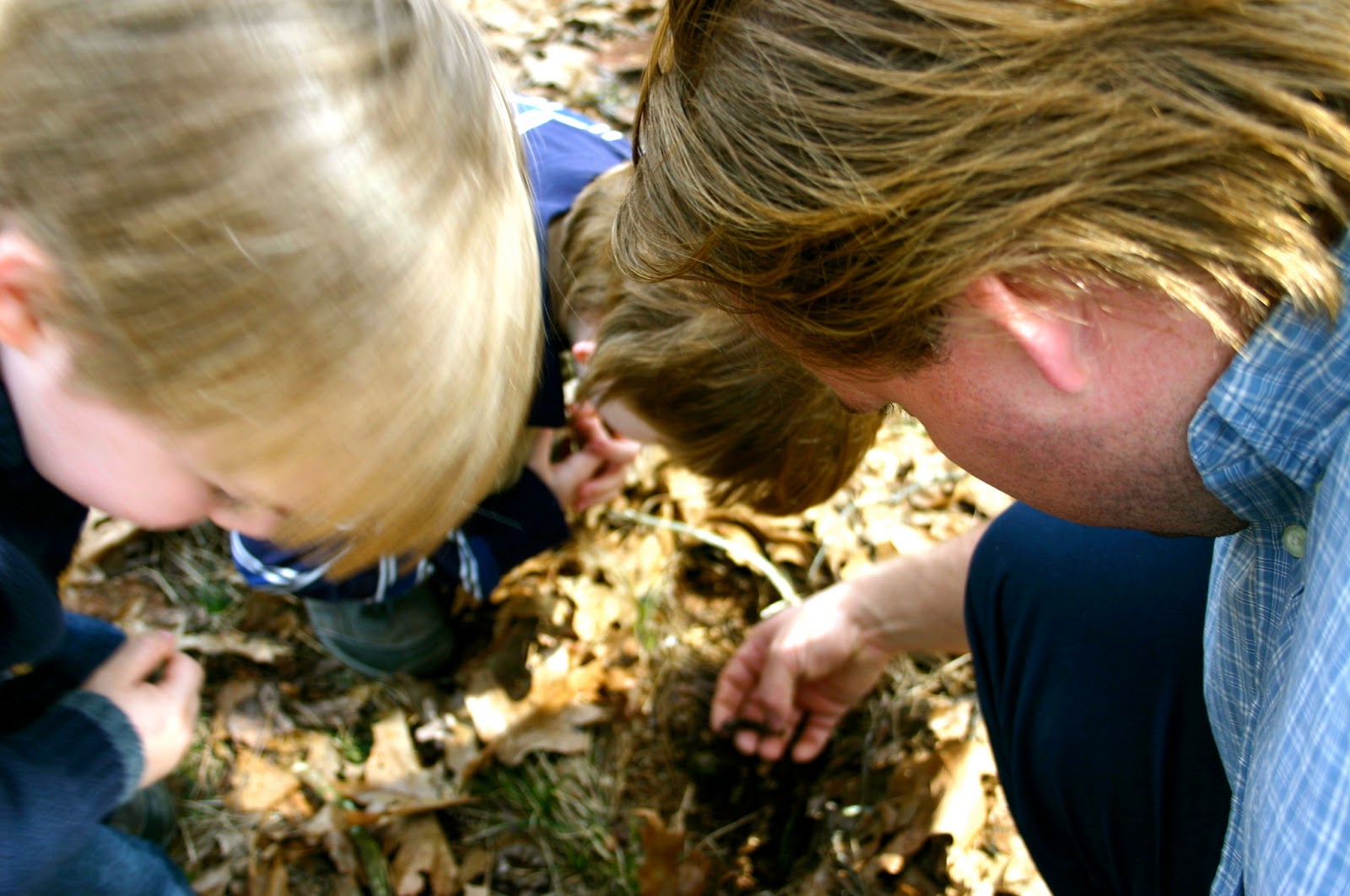
Look for local fauna. During a recent excursion along a hiking trail in Shenandoah National Park, our family saw firsthand the Shenandoah Salamander. We were able to talk a little about what the salamander eats, its ecological role, habitat, and distinguishing characteristics. Ezra exclaimed, "It's so cute!" clearly showing his fascination with appearance; and Joey was excited to talk about its diet. We also observed a herd of deer, watched and listened for specific birds (like the pileated woodpecker), and noted how a spider sat upon its web in the winds.

Joey identifying a tree. senk 2013
Relish in flora. Even if you don't know the names of every plant or tree you see, you can find out what it is by making observations while on the hike. For, example, Joey is often obsessed with cone-forming trees. If you're someplace that would allow you to take a small cone-sample (one that's fallen on the ground) or frond-sample (again, preferable on the ground), then do so. Otherwise, make rubbings, take pictures, or draw impressions of the bark, leaf or needle, and seed pod (or flower) so that you have information that can help you identify your tree or shrub with an appropriate identification guide (think, National Audubon Society, The Sibley Guide, Peterson Field Guides, Tree Finder, etc). This is particularly useful if you don't have the guide with you on the hike. I have helped Joey create his own field guide journal, in which he draws a picture of the animal or plant and then we write important information about each entry - like the common and Latin names, size, habitat, distinguishing characteristics, etc.

Give your child responsibility for a section of garden space and/or an animal. Russell built raised beds for the boys to use in growing their choice of vegetables and flowers. Joey and Ezra helped prepare and plant the beds and continue to help in maintaining them, as well. Just today, we harvested spinach, which was used for a family meal and for preserving for future use. The boys also help care for our chickens and dogs. Both are excited to spend time with the animals, as well as feed and water them. Responsibility is not the only benefit of these endeavors, however, for both boys are also nurturing compassion, which is a trait needed-more in this world.

Joey & Ezra resting along a trail. senk 2013
Life experiences in safety, human impacts on the environment, and so much more are also a part of bringing children to the outdoors. We have to realize that each person has an impact to make. If we encourage children to have a serious and respectful approach to the great outdoors, while also enjoying the beautiful gifts that nature gives to us - then, we're fostering characteristics that will help just as much with whole-self growth as with learning. Make the choice to get your kids outdoors more, today!