Showing posts with label compassion. Show all posts

Tuesday, June 11, 2013

Encouraging Acts of Kindness

Ezra gathering field daisies in The Shenandoah Valley, VA.  senk 2013
Joey and Ezra love to gather wildflowers and garden flowers, strawberries, sugar snap peas, and even eggs (from the chicken coop). But, they gather them for a purpose - usually to take to Grandmommy. 

Children have a natural propensity toward compassion. They love to create gifts for others and are quick to add hugs and kisses to the list, as well. Encouraging acts of kindness is an important part of not only homeschooling, but also life.

In our household, Joey and Ezra will find miscellaneous toys, wrap them in recycled newsprint, and then give them to one another. It's adorable to see them at such play. I keep bits of ribbon, wrappings, or bags that we got from previous gifts for them to use in their giving play. They use scraps of paper for notes; write "I love you" cards to friends and family; and make random phone calls to loved ones just to see how they are doing. I keep a mailable envelop for extended family that lives out-of-state and mail it when we've gathered a collection of their compassionate memorabilia. And, Joey is starting to type "I love you" e-mails to family with such addresses.

There are myriad other ways for children to demonstrate compassion. Perhaps you could make baked goods to take to neighbors or work at a food pantry together. Make a meal for someone in need of some tender, loving care and teach your child the power of prayer. Each morning and evening, our family has prayer time together and it's so powerful to hear them pray for friends by name. Another important skill that shows kindness is teaching children how to say a hearty "thank you" to those that bless their lives. 

How do your children show kindness? Are they gentle with animals and even bugs; do they show care for the environment? Do they offer a helping hand (such as a back scratch when it's needed) or want to make things for others? Share ways your family promotes compassion, too.

Monday, May 13, 2013

Never underestimate the outdoor adventure

Joey finding fronds while hiking.  senk 2013
Our family loves hiking. Fresh, blue skies cheer our spirits even when clouds invade. Shapes, colors, and textures delight our senses. Opportunities for exploration never end. 

One of the saddest results of building-central public schools and standardized testing, is that in many ways we've ripped away the importance of outdoor learning. It's not just that recess is often drastically cut or eliminated from the curriculum, especially when teachers and administrators feel pressed for completing testing requirements - it's beyond that. Outdoor learning - tending gardens, observing natural processes, animal husbandry, learning the names of trees, drawing outdoors, etc - is essential to education. In many public schools, financial and testing constraints have made field trips nearly impossible. So, for primary and secondary schooling to allow students the full benefits of outdoor learning, it has to occur in either a private or homeschooling environment.

There are endless opportunities for learning in the outdoor setting. Here a few ideas to get you thinking; and feel free to add other ideas in the comments section.

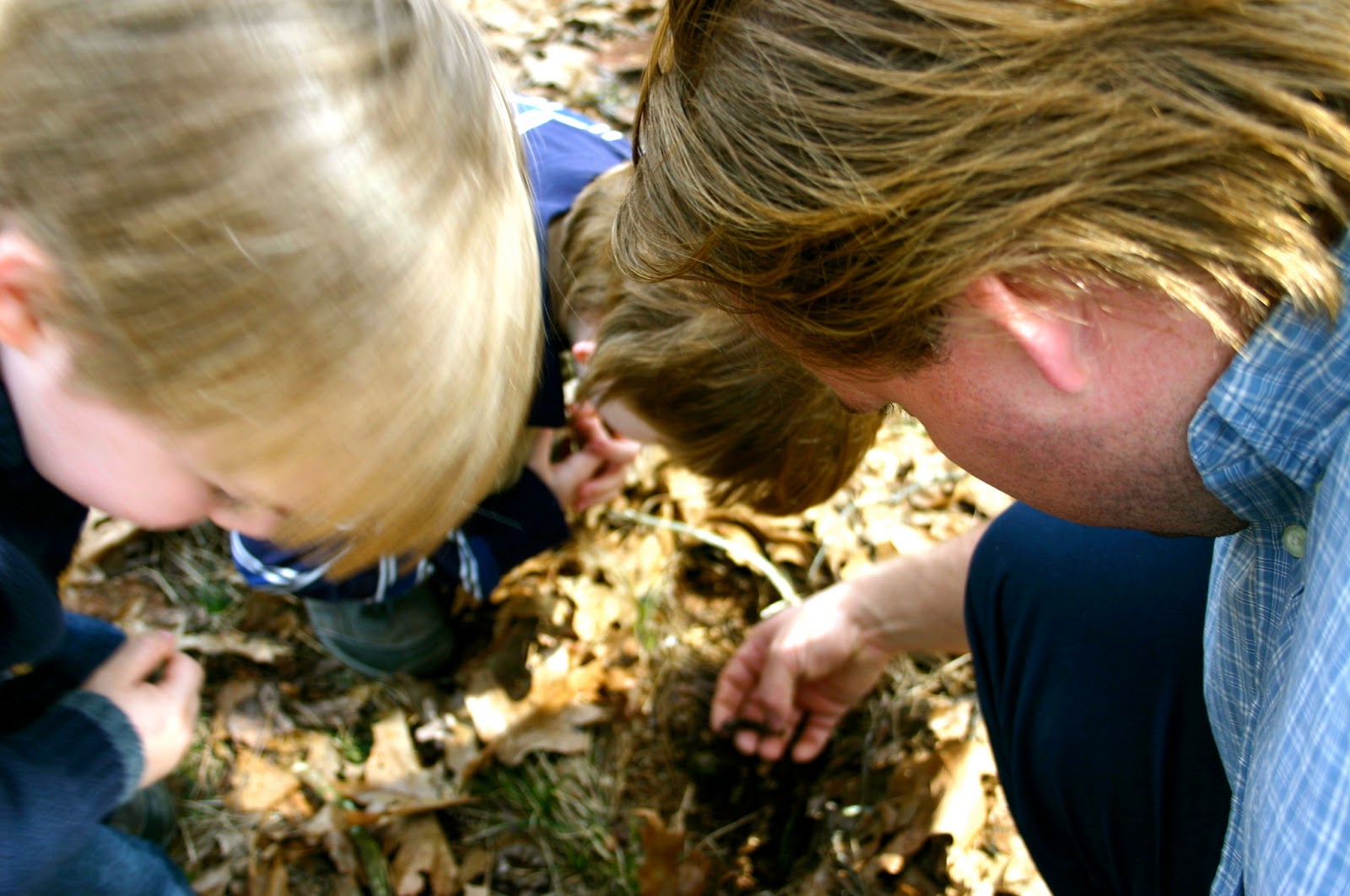
The boys investigate a salamander. senk 2013
Look for local fauna. During a recent excursion along a hiking trail in Shenandoah National Park, our family saw firsthand the Shenandoah Salamander. We were able to talk a little about what the salamander eats, its ecological role, habitat, and distinguishing characteristics. Ezra exclaimed, "It's so cute!" clearly showing his fascination with appearance; and Joey was excited to talk about its diet. We also observed a herd of deer, watched and listened for specific birds (like the pileated woodpecker), and noted how a spider sat upon its web in the winds.

Joey identifying a tree. senk 2013
Relish in flora. Even if you don't know the names of every plant or tree you see, you can find out what it is by making observations while on the hike. For, example, Joey is often obsessed with cone-forming trees. If you're someplace that would allow you to take a small cone-sample (one that's fallen on the ground) or frond-sample (again, preferable on the ground), then do so. Otherwise, make rubbings, take pictures, or draw impressions of the bark, leaf or needle, and seed pod (or flower) so that you have information that can help you identify your tree or shrub with an appropriate identification guide (think, National Audubon Society, The Sibley Guide, Peterson Field Guides, Tree Finder, etc). This is particularly useful if you don't have the guide with you on the hike. I have helped Joey create his own field guide journal, in which he draws a picture of the animal or plant and then we write important information about each entry - like the common and Latin names, size, habitat, distinguishing characteristics, etc.

Give your child responsibility for a section of garden space and/or an animal. Russell built raised beds for the boys to use in growing their choice of vegetables and flowers. Joey and Ezra helped prepare and plant the beds and continue to help in maintaining them, as well. Just today, we harvested spinach, which was used for a family meal and for preserving for future use. The boys also help care for our chickens and dogs. Both are excited to spend time with the animals, as well as feed and water them. Responsibility is not the only benefit of these endeavors, however, for both boys are also nurturing compassion, which is a trait needed-more in this world.

Joey & Ezra resting along a trail. senk 2013
Life experiences in safety, human impacts on the environment, and so much more are also a part of bringing children to the outdoors. We have to realize that each person has an impact to make. If we encourage children to have a serious and respectful approach to the great outdoors, while also enjoying the beautiful gifts that nature gives to us - then, we're fostering characteristics that will help just as much with whole-self growth as with learning. Make the choice to get your kids outdoors more, today!

Thursday, March 21, 2013

Ample Opportunities

Joey with a lime green caterpillar.  senk 2012.
In life, exposure can lead along different paths. Ultimately, though, it either leads to an unhealthy saturation centering on apathy or to a passionate pursuit of learning, exploring, and sharing such joy of life with others. In any educational environment, exposures to themes, events, and activities need to be cognitively, emotionally, physically, and socially appropriate, as well as interwoven with the interests, strengths, and weaknesses of a child. When compassion and passion collide, learning becomes positively formative for a child...

And when it does not? If we are honest with ourselves, we all know what happens to the desensitized child. Just conduct an Internet search on public school shootings or violence in video games and cartoons to assess the ways in which humanity inappropriately manipulates a child's innocence. When our children are raised with excessive exposure to violence in any form - via media, commandeering conversation, entertainment, etc - we are subliminally approving of that behavior and promoting it. Do we really want to promote violence in a broken world?

Life has myriad beauties, too. Learning about other cultures (especially new food recipes), exploring nature's intricate delicacies, maintaining a positive familial environment deeply rooted in a tradition of faith, acquiring life skills that are equalized with intellectual development (such as balancing academic, technical, trade, and other avenues of learning), etc. A life well-lived is beautiful. That is what we should be promoting for our children.

I am not promoting naivety. We define our world by opposites, whether right or wrong. But, cultivating an honest understanding of humanity's sinful self, as well as providing examples of people that have fought for a positive change in the injustices that inadvertently bubble up in life, are key accompaniments to such exposure. Even more important is waiting to expose the child when s/he is ready for such exposure. It varies from child to child, which is why homeschooling can promote the most positive environment for a child's education. The public school system in America does not allow for anyone else to follow the education of the child more than the parent. As parents, we have obligations to do our part for our children. So, if you participate in a violent video game with your child and do not implement means in which the child knows killing for killing's sake is not appropriate, your child will become another spectator at a gladiatorial event - or even a participant in the ring. Do we really want a generation demoralized to violence?

Joey in Central Park, NYC.  senk 2012.
In all, each of us assumes too much. Parents assume children learn right from wrong in the school system; while, educators assume children learn right from wrong at home; and even media assumes it's someone else's responsibility. So, take a moment and assess the exposures your child has in life. Consider how many opportunities there are in your household for encouraging healthy dialogue, promoting compassion, and developing a love of life-long learning.

Promote exposures to life adventures that integrate compassion and passion for learning. Let your child explore the beauties of life, develop positive habits, and participate in acts of caring that will help them contribute to compassionate solutions, rather than enhance the problem. This will be different based on the opportunities where you live. But, look for them and get your child involved in ample life opportunities. Often, your child will lead the way in participating in compassionate activities - don't be afraid to embrace life (even the unfamiliar) and let your light shine, too.