 |
| Joey finding fronds while hiking. senk 2013 |
Our family loves hiking. Fresh, blue skies cheer our spirits even when clouds invade. Shapes, colors, and textures delight our senses. Opportunities for exploration never end.
One of the saddest results of building-central public schools and standardized testing, is that in many ways we've ripped away the importance of outdoor learning. It's not just that recess is often drastically cut or eliminated from the curriculum, especially when teachers and administrators feel pressed for completing testing requirements - it's beyond that. Outdoor learning - tending gardens, observing natural processes, animal husbandry, learning the names of trees, drawing outdoors, etc - is essential to education. In many public schools, financial and testing constraints have made field trips nearly impossible. So, for primary and secondary schooling to allow students the full benefits of outdoor learning, it has to occur in either a private or homeschooling environment.
There are endless opportunities for learning in the outdoor setting. Here a few ideas to get you thinking; and feel free to add other ideas in the comments section.
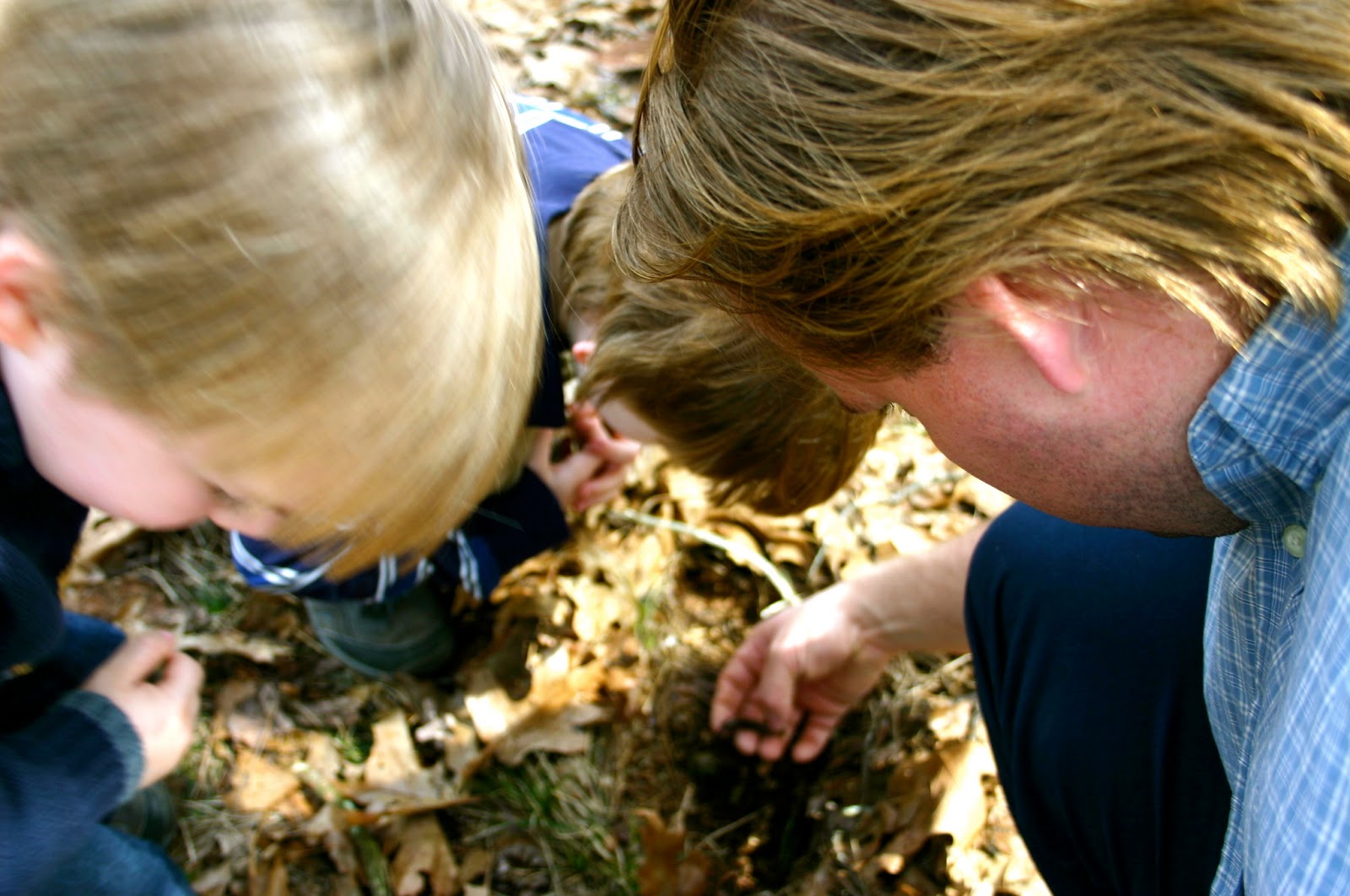 |
| The boys investigate a salamander. senk 2013 |
Look for local fauna. During a recent excursion along a hiking trail in Shenandoah National Park, our family saw firsthand the Shenandoah Salamander. We were able to talk a little about what the salamander eats, its ecological role, habitat, and distinguishing characteristics. Ezra exclaimed, "It's so cute!" clearly showing his fascination with appearance; and Joey was excited to talk about its diet. We also observed a herd of deer, watched and listened for specific birds (like the pileated woodpecker), and noted how a spider sat upon its web in the winds.
 |
| Joey identifying a tree. senk 2013 |
Relish in flora. Even if you don't know the names of every plant or tree you see, you can find out what it is by making observations while on the hike. For, example, Joey is often obsessed with cone-forming trees. If you're someplace that would allow you to take a small cone-sample (one that's fallen on the ground) or frond-sample (again, preferable on the ground), then do so. Otherwise, make rubbings, take pictures, or draw impressions of the bark, leaf or needle, and seed pod (or flower) so that you have information that can help you identify your tree or shrub with an appropriate identification guide (think, National Audubon Society, The Sibley Guide, Peterson Field Guides, Tree Finder, etc). This is particularly useful if you don't have the guide with you on the hike. I have helped Joey create his own field guide journal, in which he draws a picture of the animal or plant and then we write important information about each entry - like the common and Latin names, size, habitat, distinguishing characteristics, etc.
Give your child responsibility for a section of garden space and/or an animal. Russell built raised beds for the boys to use in growing their choice of vegetables and flowers. Joey and Ezra helped prepare and plant the beds and continue to help in maintaining them, as well. Just today, we harvested spinach, which was used for a family meal and for preserving for future use. The boys also help care for our chickens and dogs. Both are excited to spend time with the animals, as well as feed and water them. Responsibility is not the only benefit of these endeavors, however, for both boys are also nurturing compassion, which is a trait needed-more in this world.
 |
| Joey & Ezra resting along a trail. senk 2013 |
Life experiences in safety, human impacts on the environment, and so much more are also a part of bringing children to the outdoors. We have to realize that each person has an impact to make. If we encourage children to have a serious and respectful approach to the great outdoors, while also enjoying the beautiful gifts that nature gives to us - then, we're fostering characteristics that will help just as much with whole-self growth as with learning. Make the choice to get your kids outdoors more, today!


