Showing posts with label learning. Show all posts

Wednesday, September 4, 2013

Try, try again...

From Noah to Descartes to Newton, rainbows have fascinated people for years. And no less do they fascinate Joey and Ezra. During our prior-to-school's-start brainstorming sessions, when the boys revealed some of the topics they wanted to cover during their school exploration times (like volcanoes and bugs), the rainbow was second on the list. But, how do you cover such a complex topic of physics with such young children?

Recently, a line from Walter Lewin's For the Love of Physics has been resonating in my mind. He says, "What counts, I found, is not what you cover, but what you uncover" (2011:2). He continues, "Uncovering the laws of physics and making them see through the equations,... demonstrates the process of discovery, with all its newness and excitement..." His observations apply to any subject at hand. It's the passion, the discovery, and the applicable meaning that we harbor in our hearts during learning. And for young children, that means hands-on and up-close.

Obviously, I employ manipulatives in my teaching. The more experiments and activities (beyond worksheets and the ordinary), the better. But, any scientist-at-heart will tell you that experiments and trial-and-error go hand-in-hand. So, in order to cover rainbows, I turned to some great books* with experiments on light, prisms, and refraction. Some of these were major failures (yes, homeschoolers have those), but that's where the best parts of learning come in: perseverance and creativity. We worked together to brainstorm ways to make our experiments work and tried again, and even again. That's where the successes occurred (yes, homeschoolers have those, too).
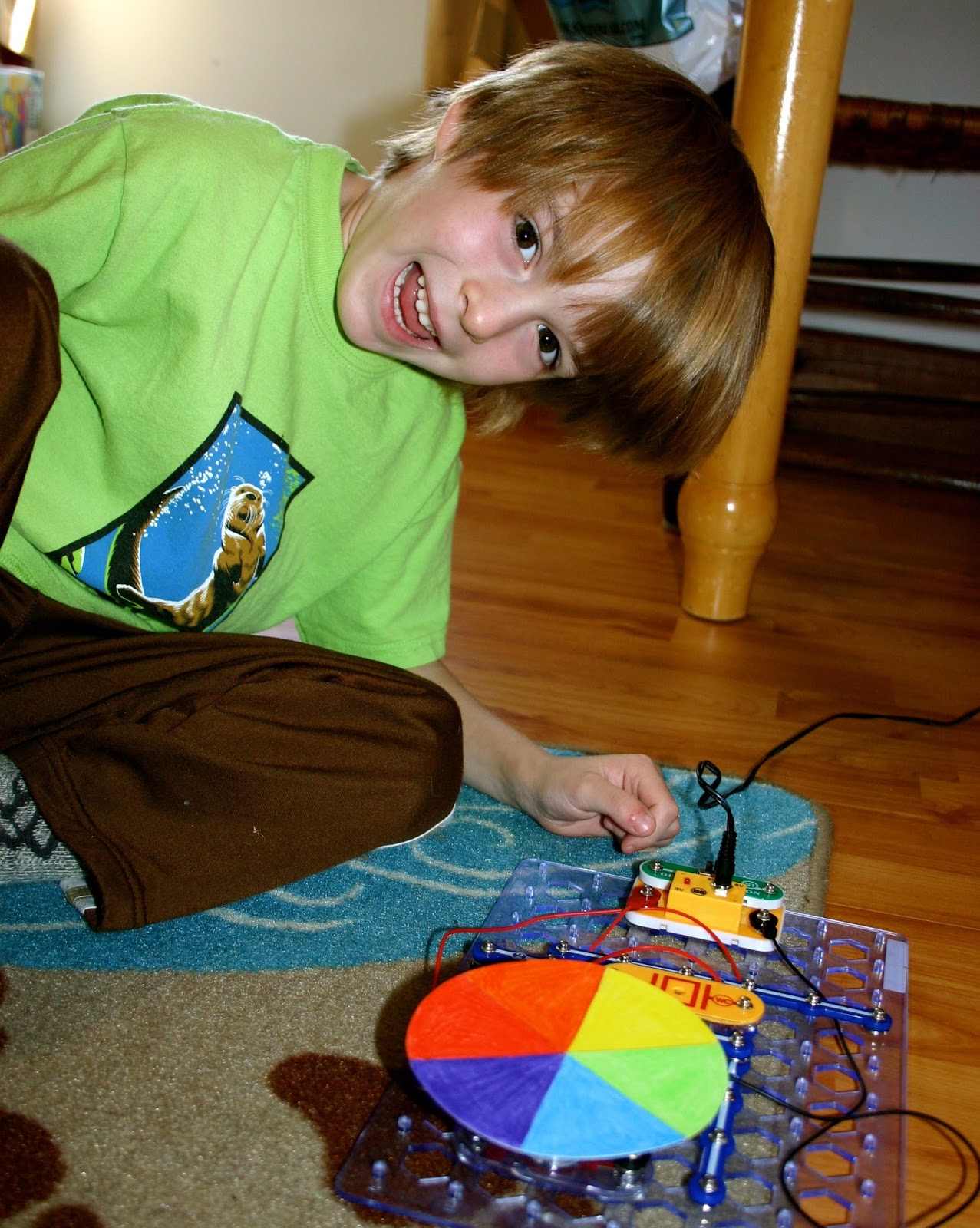
Joey w/ his snap circuit color wheel.  senk 2013
We began our exploration on how rainbows are made with bending light. I wanted Joey to see how light bends, because that's how it happens inside a raindrop. So, we followed Science Lab: The Ultimate Science Pack and completed "Laboratory 6: Which Way Does Light Go?" This experiment worked really well and Joey had a splendid time using multiple mirrors and using his imagination to explore bending light. The next obvious step was to experiment with a prism and allow sunlight to create a spectrum on the floor, on the wall, on our hands. The boys were delighted to look for spectrums and Joey wanted to draw one. So, I introduced him to Roy G Biv, that scintillating character many of us learned about in Art Class. We combined paints so Joey could see how secondary colors were created from primary colors (here, I'm referring to the pigment-based primaries: red, blue, and yellow; and yes, we also explored the primary colors of light - red, blue, and green - too); and, we talked about Newton and explored Newton's color wheel. It took three attempts before we finally got the colors to vanish into the all-inclusive white, indicative of sunlight.

A closer view of his set-up.  senk 2013
With "Laboratory 5: Vanishing Colors" of Science Lab, we focused on the concept of white light being a combination of many different colors. But, this experiment was based on creating a top that would spin to blur the spectrum into white. While it's good in theory, in actuality, we could not spin the top fast enough for white to result. So, I spearheaded another experiment from The Optics Book: Fun Experiments with Light, Vision & Color by Levine & Johnstone (1998). The idea was to create a Rainbow Wheel that twisted on string between your fingers. Another good idea in theory, but we just couldn't twist the wheel fast enough to see white from the spectrum. So, what could we do? Then, the Eureka moment came: Joey's snap circuit set! Using the red rotating wheel, Joey set up a circuit that would allow the rotator to turn really fast. I taped our color wheel to the rotator; Joey placed it just right; then, he flipped the switch. The rotating wheel was spinning so quickly we easily saw a spectrum of color zip into white light. How dazzling!

Of course, Joey was thrilled and so excited. And, while I was thrilled the experiment finally worked, I was more excited that Joey saw how (even over the course of a few days) it pays to persevere. I know there are going to be moments of frustration, exhaustion, and confusion in homeschooling; however, I also know that we never have those feelings without their opposites. So, let's toss a little courage into the mix and see what happens.


* Examples of books we read or used for these lessons (nota bene: this is just a sample; there are other competent resources - this is by no means an exhaustive list):

Arvetis, Chris & Carole Palmer, "What Is a Rainbow?" A Just Ask Book. 1983.

Barton, Chris. The Day-Glo Brothers: The True Story of Bob and Joe Switzer's Bright Ideas and Brand-New Colors. Watertown: Charlesbridge, 2009.

Burnie, David, "Light." Dorling Kindersley Eyewitness Books. 1992, pp. 28-33.

Carle, Eric. Hello, Red Fox. 2001.

Levine, Shar & Leslie Johnstone. The Optics Book: Fun Experiments with Light, Vision & Color. New York: Sterling Publishing Company, Inc, 1998.

Lewin, Walter. For the Love of Physics: From the End of the Rainbow to the Edge of Time - A Journey Through the Wonders of Physics. New York: Free Press, 2011.

Science Universe Series, 1984."Sight, Light and Color," pp. 18-19, 26-27, 34-35, 47.

Stewart, Melissa. Why Do We See Rainbows? New York: Marshall Cavendish, 2009.

Monday, August 19, 2013

A priceless picture

Joey (5 yrs) on his first day of school.
Opening envelops and reading words of encouragement on the cards we received from many family members and friends, Joey delighted in the love and support that surrounded his first day (and week) of Kindergarten. Although we did some basic assessment the first week of school, such as ascertaining his knowledge-base of the alphabet, numbers, writing his name, blending phonemes, rhyming, etc, Joey (and Ezra) had tons of fun amidst the learning.

No, the first day of school did not entail my son, loaded with a backpack, standing at the end of the sidewalk and waiting for a big yellow bus to appear on the horizon. No, the Pledge of Allegiance was not the first recitation of the day (or even a part of his day). No, my son did not experience the climate of a large-class environment.

Instead, he prepared for the day (even wearing a beaded necklace that he threaded over the weekend), helped clean up after breakfast, and then started the day with our usual morning worship service. He recited the Lord's Prayer with me, did a scavenger hunt to discover his Bible verse for the week, and then learned about the importance of volcanoes in creating the atmosphere for our planet in the early stages of Earth's history. Over the course of the first week, we compared the creation story with the geological time scale; and surmised from this highly-constroversial topic that God created the earth and all that is in it - regardless of how scientists and theologians hash it out. We made a paper-mache volcano (thanks to an Amazon packing box, Elmer's glue, shreds of Northern Virginia Daily, a recycled Stonyfield yogurt tub, and an empty spice container), painted it, and plan to "erupt" it as close to August 24th as possible (yes, I'm a classical archaeologist at heart). Joey learned that heat and pressure are two important necessities for a volcanic eruption to occur. We used the "Fountains of Fun" activity in Laboratory 13 of the "Science Lab: The Ultimate Science Pack Laboratory Manual" (1997:28). The experiment requires filling an empty plastic bottle 2/3 with water, shoving in a drinking straw, sealing the opening around the straw with modeling clay, and then blowing air into the bottle through the straw. The boys were delighted to see the jettison of water result when they moved their lips from the straw. This was a good way to illustrate pressure's importance in a volcanic eruption. To illustrate heat, I plan to melt red wax in a water-filled beaker - but, that's week two.

Ezra, the robot - up close and personal.
Amidst the science fun, the boys reviewed numbers, played Sequence Letters, learned the concept of one less and one more, and became more familiar with a globe, magnets, levers, and a balance. Joey is enjoying the beginnings of German, piano, and has art-infused into each day. But, there is still so much time for them just to have creative play. For example, during the second day of school, the boys claimed a larger Amazon packing box for the basis of a robot costume they wanted to make. I helped them by cutting out holes with an exact-o knife, but otherwise, the ideas were their own. They each had fun wearing the costume around the house and decorating the box with creative shapes and colors.

I had no idea what to expect for the first week. I definitely did not expect quite so much creative play and demand for learning. The boys are so inquisitive - and, I have to try to keep up with their yearning to know more. It was an exhausting week. And, I felt my public-school-learned self pushing against the more liberal way of homeschooled learning with less rules and more freedom. The best advice I received from an inspiring friend was to have patience with myself. Perhaps I have much more to learn than my boys do!

Tuesday, April 23, 2013

Resources for outdoor adventures

Russell with a heart-shaped treat. senk 2013
Earth Day should really be a part of every day. That is what I'm teaching my boys.

Messages of savoring nature's beauty, appreciating the hard work of gardening, and interacting with the real world out there are mingled throughout their homeschooling curriculum. But, it's more than just a curriculum; it's a way of life. Learning is as much a part of living as living is of learning.

No matter where you live, there are ample opportunities to enjoy (often free) activities that help your children get into the great outdoors. In the Shenandoah Valley, our family frequents Shenandoah National Park - hiking along paths that start along Skyline Drive's slow meander along the mountain crest. An annual pass pays for itself by the second or third trip, so we make that an anniversary gift each August. In addition to state or national parks, consider visiting town parks (which often splash natural colors and textures even amid cityscapes) or zoos or vineyards or living museums or farm markets, etc. For Earth Day, our family ventured to Stanley, VA, and helped to plant grapevines at Wisteria Vineyard. We relished the family time traveling over Massanutten Mountain. As enjoyable as the (free) event was, our family also learned (together) many valuable lessons: how to properly plant a grafted grapevine (which can be applied to any grafted plant), the importance of working together (many hands really do lighten the workload), how to follow directions and observe carefully, etc. By the end of the morning, Joey could properly stake a vine and Ezra was a master at gently placing grapevines into prepared holes. And, did I mention, the learning was free!

Joey & Ezra at Wisteria Vineyard.
senk 2013
It can be difficult to find those few good resources that yield information on fun outdoor events in your area.  But, be diligent - ask friends and family, surf the Internet, and ask proprietors of the places you frequent. Where I live, a great resource for upcoming events and places to visit is "The Shenandoah Valley of Virginia and West Virginia." Click on the "More events" link in the "Things to Do" box on the bottom lefthand side of the webpage. Then, peruse the plethora of opportunities which are listed in order of date. If you're visiting the Shenandoah Valley, this is a great place to start discovering events or locales in an area you may enjoy. 

Often, some of the most exciting outdoor excursions are unexpected ones. Just be open to new learning experiences - especially ones you can do as a family. Not only do you create meaningful memories, but you weave more closely the threads of learning, living, and loving.

Monday, November 19, 2012

"Mommy, may I help?"

Young children have a naturally inquisitive side. They want to explore the world around them. And, they love to help!

Joey and Ezra are quite quick to say, "Mommy, may I help?" While a part of me wants to accomplish a task as quickly as possible, another part of me wants to include my children in the activities I do. By doing so, the child fulfills a love of curiosity, learns life lessons and skills, and recognizes his own value in the family (and in the world). Me? I learn patience, rediscover the excitement of my tasks, and bond with my children by completing activities together.

When we allow children to help direct some of their learning by engaging in activities of interest, children learn at an accelerated rate. For example, both Joey and Ezra have learned a lot about harvesting food and seeds by helping to glean seeds from okra, scoop and separate seeds and roasted meat from pumpkins, cut up apple chunks for boiling into sauce, as well as gathering an assortment of food from the gardens: potatoes, green bell peppers, scallions (their favorite to harvest), basil and oregano, tomatoes, etc. Joey would sit for hours popping popcorn kernels from the cobs.

But, here's the catch. I did not ask or demand my children to do any of these things! Either Russell or I started working on a project and the boys merrily joined in. As Joey gets older, he's asking to do more and more: gather eggs from the coop, help carry firewood (especially when we're loading up the stoves), vacuum dust from the floor, even cleaning the bathroom. It surprises me every time Joey expresses such interest in exploring the world around him. However, I am certain that if I did not allow him to help, but denied his desire to help, he would stop asking.

Now there is a caveat. While allowing my children to perform the tasks they want, I also set boundaries to help them be safe while learning about the necessities of life activities. For example, they know to only handle blunt butter knives when helping with cutting fruits or vegetables, and only when they ask Mommy or Daddy first. Similarly, while Joey and Ezra can help carry wood to the fireplace, they know they are not allowed to put wood into a burning stove. Both boys know they have to wash their hands with soap and water before helping prepare food. There is a plentitude of opportunity to gently teach children what such boundaries are, as well as why they are important. Setting such boundaries takes time and consistent reminding, but over time beneficial boundaries will stay with the child.

So, the next time your young (or older) child asks to help, consider it an opportunity for learning. Learning is not restricted to "academic" subjects and even the academic subjects - reading, writing, mathematics, science, social studies, etc. - are evident in the simplicity of day-to-day life. Consider what your child will need to know and how the routines in everyday life are just as important to master as correctly pronouncing phonemes as a basis for reading. 

Let your child help! And, take a moment to post about it in the comments section below.

Monday, September 17, 2012

Where do you see ABCs?

The letter C found in nature.
Over the past year, as Joey has become more and more familiar with his alphabet, the letters have become more predominant in the world around him.  On our nature walks, he sees an L-shaped rock or Ys running down tree bark.  Sometimes I will ask him if he sees any letters in the landscape, but most of the time, he looks for them on his own. 
A is for acorn.


As Joey more formally learns the ABCs, I have tried to use activities to help him point out letters in a way beyond pencil and paper.  Long yarn pieces and cooked spaghetti noodles make great tools for shaping the curves and lines of letters.  With fun music playing, we dance and use our bodies to shape more than just Y, M, C, and A.  We match objects with initial sounds, not with pencil and paper, but with real candles, combs, cars, and carrots, which are intermixed with a shoe, a button, a pencil, and a star.  Or, if we want to highlight other letters, we choose objects that allow us to do that.  Other times, I display four objects and four small letter cards, then ask Joey to put the letter with the correct object based on the initial sound.  

Right now Joey picks out letters, but before too long, he'll be able to manipulate the letters into words or even phrases.  A lunchtime bowl of alphabet soup is perfect for assessing what he knows, because it allows him to pick out and name letters.  Older children could practice spelling words or creating phrases with letters swimming in a cup of alphabet soup.  Often, a sales flyer or outdated magazine provides a means for circling letters with a marker or cutting out letters for pasting on a collage.  The possibilities really are endless and benefit from a pot of creative simmering.

Stars indicate the letter A.
One activity Joey enjoys uses recyclables and stickers: two things he loves!  Rummaging through the recycling bins, I pick out three or four items for him to use in finding the letter of the day.  For example, when we are talking about A, I give Joey a yogurt top, an aluminum foil holder, and a cookie box.  He uses the stickers to place on all the As, upper and lower case, he can find.  I am always amazed how well he does and he usually runs out of stickers before he can star every letter he finds!  Meanwhile, Ezra (not to be excluded from any activity Joey does) uses stickers to create a Dali-inspired bit of artwork.


Joey finding A on some recyclables.

In what ways does the alphabet creep up in your home learning environment?

Friday, September 14, 2012

A truly rollable cookie recipe for learning ABCs

Clay is a great manipulative for coiling into shapes like letters and numbers, as much as it is a means for creating functional pottery.  The smooth, soft feel of clay fascinates most people, who are not squeamish with getting a bit dirty, and especially children.  Joey and Ezra are quite fond of folding their hands around a blob of turning clay on a potter's wheel; shoving carving tools into a patted ball of clay so as to create a porcupine or pincushion or other needly object; sponging water rings through the clay-covered wheel as it turns and splatters. 

Joey forming a cup at the potter's wheel.
Both boys thoroughly enjoy playing with miscellaneous doughs inside the house as much as in the pottery studio.  But, it is difficult to find a yummy cookie dough that is as much fun to make and manipulate as it is to eat once it's baked.  So, after studying several recipes from Greek cookbooks (who doesn't love "The Complete Greek Cookbook" by Theresa Karas Yianilos), the Internet (which largely provides a plethora of options for roll-out sugar cookies and tons on inedible baker's clay or play-dough), and a mass-letter producing recipe from a Good Apple Teaching Resource book entitled "Rainy Day Fun," in which their ABC "Mud" Cookies (1987:22) inspire more attention, I decided to make my own recipe for Chocolate Alphabet Cookies.

Chocolate is a much loved treat in our household; so, too, are finding letters in everyday items.  Of course, my Alphabet Cookies provide a good helping of all-natural cocoa, in addition to some healthier alternatives for baked cookies.  But, an even more admirable characteristic of this dough, is that it really is a dough.  Perhaps if your preferred method is rolling out and stamping shapes from cookie dough, you could still do that, but the elasticity present in the unbaked state of Chocolate Alphabet Cookies provides the manipulative factor that allows my boys to roll coils that then become alphabet letters and numbers.  Their hands (and a baking sheet or four) are the only tools needed, once the dough is made.  No cookie cutters (and, not everyone owns an array of alphabetic cookie cutters, anyway), no rolling pins, no flour or powdered sugar to cover the surface, just the soft and pliable wad of cookie dough and two imaginative boys (and their mommy and daddy).

Joey with his JOEY chocolate ABC cookies.
Joey has become a master of forming J - O - E - Y in the clay-inspired cookie dough. Ezra needs more help, but he can already pick out some of the letters.  We can create their names, the entire alphabet, and still have enough dough leftover to make fun shapes and objects, like stars, snakes, spirals, geometric shapes, et cetera.  The recipe even lends itself well to variations and your imaginative additions: try frosting the baked shapes and donning them with sprinkles, use a flavor other than chocolate as the base, push white chocolate or peanut butter chips into the shapes before they bake, use coconut shavings or walnuts or myriad other additives to create textures or interest (both in taste and sight) to your letters and shapes.  The ideas really are endless, but at the core of it is a fun dough recipe you can use as a manipulative to teach your children the alphabet, numbers, basic shapes, and a variety of rudimentary knowledge (e.g. older children could roll out important dates and create an image that represents the important event they need to know, such as 79 AD and an image of Herculaneum covered in mud at the base of Mt. Vesuvius or an array of elephants crossing over the Pyrenees into Italy for 218 BC during the Second Punic War when Hannibal crossed the Alps to attack the Romans).

Ezra displays his EZRA chocolate ABC cookies.
And, without further ado, the recipe...

CHOCOLATE ALPHABET COOKIES

Ingredients:
2/3 cup whole wheat flour
2 1/3 cups all purpose flour
1/4 cup milled flax seed
1/4 cup ground almonds
1/2 cup unsweetened cocoa powder
1 teaspoon cinnamon
1/2 teaspoon salt
dash of nutmeg
2 hard-cooked egg yolks (see step 1)
1/2 cup brown sugar
1/4 cup honey
1/4 cup cold unsalted butter
1/4 cup coconut oil
1/4 cup extra virgin olive oil
2 large eggs
1 teaspoon pure vanilla extract

Directions:
1.  After covering two eggs with water in a small saucepan, bring them to a gently rolling boil.  Continue boiling for 10 minutes.  Turn the stove's burner off and let set for 2 minutes.  Then, drain the water and spray the eggs with cold water for a minute or so.  Then peel the eggs and separate the yolks from the whites.  Let your children eat the whites while you, after acquiring a small bowl and a fork, mix the egg yolks into the brown sugar.  Set aside.
Dry ingredients mixed with hard yolks, sugar, & butter.
2.  In a large bowl, add the flours, flax seed, ground almonds, cocoa powder, cinnamon, salt, and nutmeg.  Stir together.  Then, cut in the butter until it is well incorporated.
3.  Add the oils, sugar with yolk, honey, eggs, and vanilla extract, mixing together well.
4.  Knead the ingredients together, starting out in the bowl, then turning the dough onto a clean tabletop.
5.  Preheat oven to 350 degrees.
6.  Once the dough is formed, pinch some off, roll into a coil, and shape accordingly.  Nota bene: it is easier to shape the letter or number on the baking sheet rather than transferring from the tabletop to the sheet and especially so if the shape is particularly large.  Coils should be about the size of your little finger, unless you want giant shapes.
Shapes before baking.
Wet ingredients ready.
7.  At this point, you can add any extras to the designs, such as chocolate or peanut butter chips, various nuts or candies, shredded coconut, etc.  Or you can wait until they are baked and decorate with frosting and other additives.
8.  Bake in a preheated oven for about 10 minutes (adjusting bake time based on thickness of coils).  Then, cool.  You can store these in an air-tight container or zipper bag, preferably in the refrigerator for longer lasting use. 

Once your Chocolate Alphabet Cookies are cool, use them to spell words, practice visualizing the alphabet song, or just to see what letters your child knows.  If you made upper and lower case versions of the letters, play a scrambled matching game to see if your child can match the big and little letters.  If you made numbers, use them for addition, subtraction, multiplication tables, a number line, or a wide array of mathematic considerations.  Let your imagination soar and introduce your cookies into aspects of education you may never before have considered!  And, please do share how your family uses this recipe.